Frag Maxi.
The AI phone assistant that's actually a control room. Built for craft businesses, fully configurable, no AI knowledge required.

No specific reason for the call identified.
Internet connection or electricity meter reading.
Removal request from wall or ceiling.
Installation or replacement request.
- Role
- Solo Senior Product Designer
- Owned
- UX & UI, end-to-end
- Surface
- Configuration platform + voice agent
- Team
- CEO · CTO · 2 engineers · me
- Period
- 2025
The real brief wasn't an AI. It was a control room.
Frag Maxi is an AI phone assistant, powered by Meisterwerk, for craft businesses. A missed call is a missed job, the owner's on a roof, the team's in the basement, the phone just rings.
The AI answering the phone was never the hard part. The hard part was the platform behind it, where a plumber, an electrician, or a pest control operator defines exactly how their assistant behaves, without needing to understand AI, prompts, or agent architecture.
Team: CEO, CTO, 2 engineers, me. I owned UX and UI end to end.
My job: make complex AI orchestration feel like briefing a new colleague.
The agent is the output.
The platform is the real product.
Defining a framework non-technical users could actually hold in their head: call reasons, tasks, caller types, behaviours.
Making AI call logic editable, who calls, why, what to collect, how to respond, without exposing a single line of logic.
Different trades have entirely different call patterns. The platform had to support that without becoming a custom build for each.
Helping users understand what information is collected per call, when, and why, and how to read and use it afterwards.
Making automation feel reliable. The owner hands control to an AI, the platform had to make that feel safe, not scary.
Translating AI logic into something a plasterer can edit.
Under the hood, Maxi is a complex orchestration of call flows, conditional logic, data collection rules, and escalation paths. None of that could be visible to the user. The design problem was building a mental model that felt simple enough to configure in 20 minutes, but expressive enough to handle a heating engineer's needs differently from a pest control operator's.
Every decision on the platform surface came back to the same question: how do you make AI behaviour editable without making it feel like programming?
Here’s what that looks like in practice.
Same call reason, different behavior depending on who’s calling.
The call reason is the unit of configuration.
Different trades plug entirely different call reasons into the same structure. A boiler breakdown and a mold inspection look nothing alike, but both follow the same shape, and both ship pre-built, ready for the owner to edit.
Users didn't want to edit a template. They wanted to describe what they needed.
Owners felt constrained mapping their business onto a template that wasn't designed for them. What worked: describe the call reason in plain words, let Maxi generate the structure, then review and activate. Configuration became conversation.
Choose a template. Edit each field.
High drop-off. Users couldn't fit their business into a structure built for someone else.
Describe it. AI builds it. You review.
Two steps. Owners described the need, Maxi generated the full call reason, completion rate improved significantly.
We built an agent to configure the agent.
Self-serve wasn't the answer for everyone. Many craft business owners, often older and not particularly tech-driven, didn't want to learn the platform. Even after onboarding videos, a guided wizard, and help articles, they kept calling support for things that already existed on screen. They didn't want documentation. They wanted to stop navigating.
The fix used the same technology the product was already built on. A voice agent now sits inside the configuration platform itself. An owner taps it, says what they want changed, and the agent walks them through it or makes the change directly, the same way Maxi handles their customers' calls. Maxi configures itself.
Spoken once. Structured automatically.
“Add a call reason for burst pipes, ask about location and whether the water’s shut off.”
Maxi listens,
structures,
matches.
Burst pipe
The call ends. The information stays.
Every call produces a structured summary: caller identity, why they called, what was collected, urgency, and any follow-up actions. Owners needed to understand at a glance what happened, what Maxi collected, and what to do next, so each field is labelled clearly, each action visible.
The full call log is filterable by caller type, call reason, outcome, and date. If a new type of call starts coming in and no call reason covers it, the owner spots the pattern and updates the configuration from the same view.
Not just surfacing data. Making it trustworthy enough to act on.
Every call, every decision, every piece of collected data is visible to the owner at any time.
If Maxi behaves in a way the owner didn't expect, they can find it, understand why, and change the configuration.
Maxi escalates instead of guessing. It never promises what it cannot deliver, and always names its limits clearly.
All data on German servers. Owners can view and delete any recording at any time.
Three things designing a configurable AI taught me.
The mental model is the product.
Before any screen existed, the work was defining a model users could hold in their head: call reason, tasks, caller type, behaviour. Once that clicked for users, every screen became easier to design and easier to use.
Configuration is a product, not a settings page.
The design challenge wasn't exposing controls. It was making the owner think clearly about their own business, what calls come in, from whom, and what matters in each case, without it feeling like work.
Trust is designed, not assumed.
Handing control to an AI is a significant ask. Every design decision, visibility, editability, escalation, was about making that handover feel safe enough to actually happen.
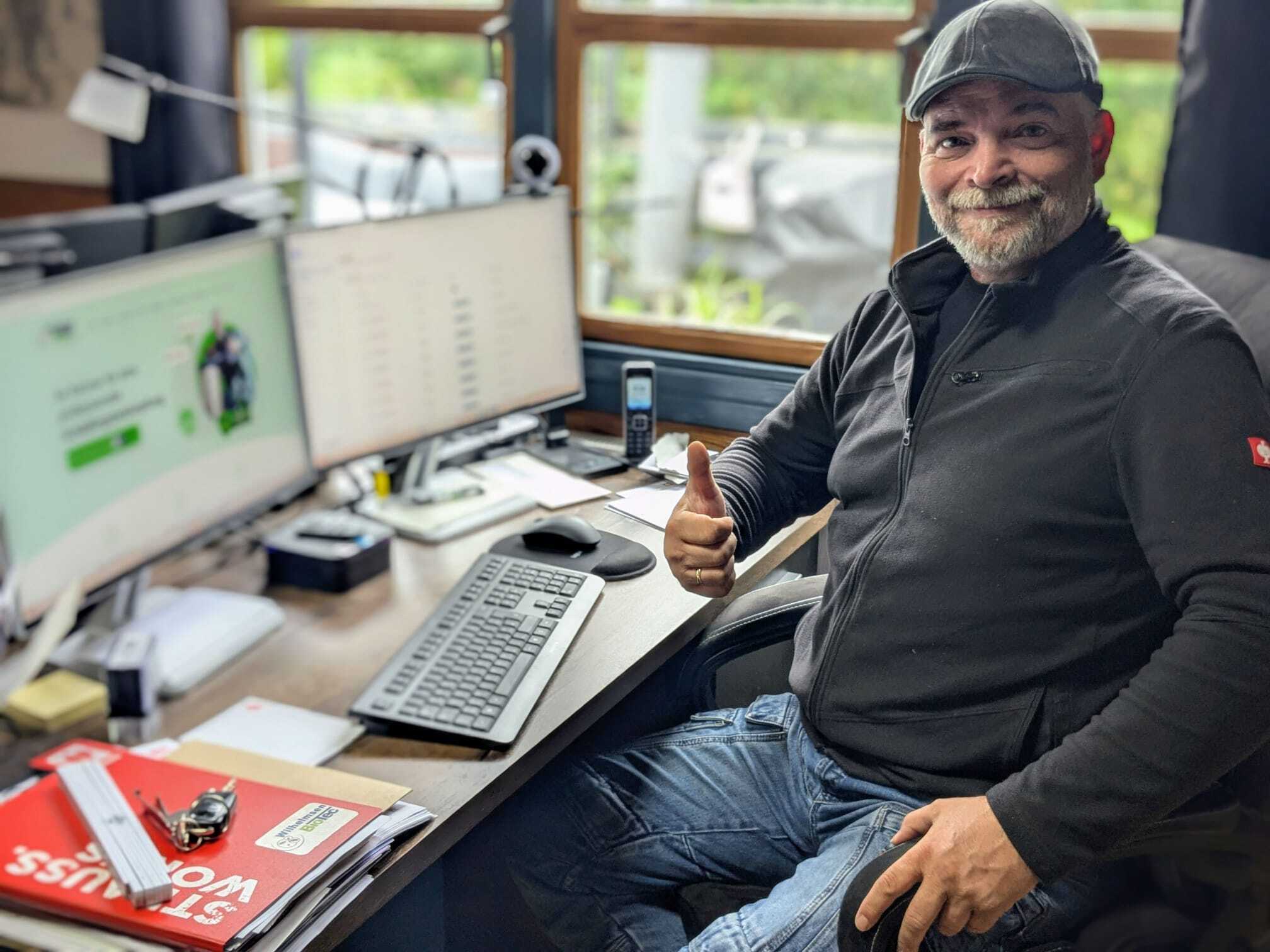
“With AI phone assistance, you feel better picked up than with an answering machine.”
Björn Wilhelmsen · Pest control business owner, early Maxi customer
What I'd carry forward.
Frag Maxi was the first time I designed not just for a user, but for the relationship between a user and a system they cannot fully see. The AI does the work, but the platform is what gives the owner the confidence to let it.
The thing I am carrying forward: making complex systems configurable is a design problem, not an engineering one. The hard work is defining the right mental model, finding the right level of abstraction, and building enough transparency that people trust what they cannot watch in real time.
General Metrics & Outcomes