Cense.
End-to-end design for a regtech platform. Built for compliance officers at financial institutions to monitor and report on clients' crypto assets.

- Role
- Lead & Sole Designer
- Team
- Cross-functional, full stack
- Surface
- Web app, client portal, PDF reports
- Scope
- End-to-end across the company
- Period
- 2023 to 2024
Built from scratch.
By the people who already knew how to catch crime.
One of our founders worked directly with RIEC, the Dutch Regional Information and Expertise Centre for organized crime, helping investigators trace illicit crypto activity by hand. That became the seed of Cense.
We were a founding team of twenty: developers, compliance officers, crypto specialists, and one product designer. The team had previously built and sold a crypto tax product together. Cense was built from scratch, with that experience behind it.
Cense provides advanced compliance solutions for financial institutions managing clients with crypto assets. Banks use it to onboard crypto-holding clients, run risk analyses, and produce regulator-ready reports, fully compliant with AML and MiCA regulations.
The Crypto Holder
Individual proving their assets are legitimate to their bank.
Connect PortalThe Financial Economic Crime Specialist
Inside the bank, reviewing submitted cases and flagging risk.
Admin PanelThe Compliance Officer
Reading the final report to make an approval or rejection decision.
Risk Analysis ReportConnect Portal.
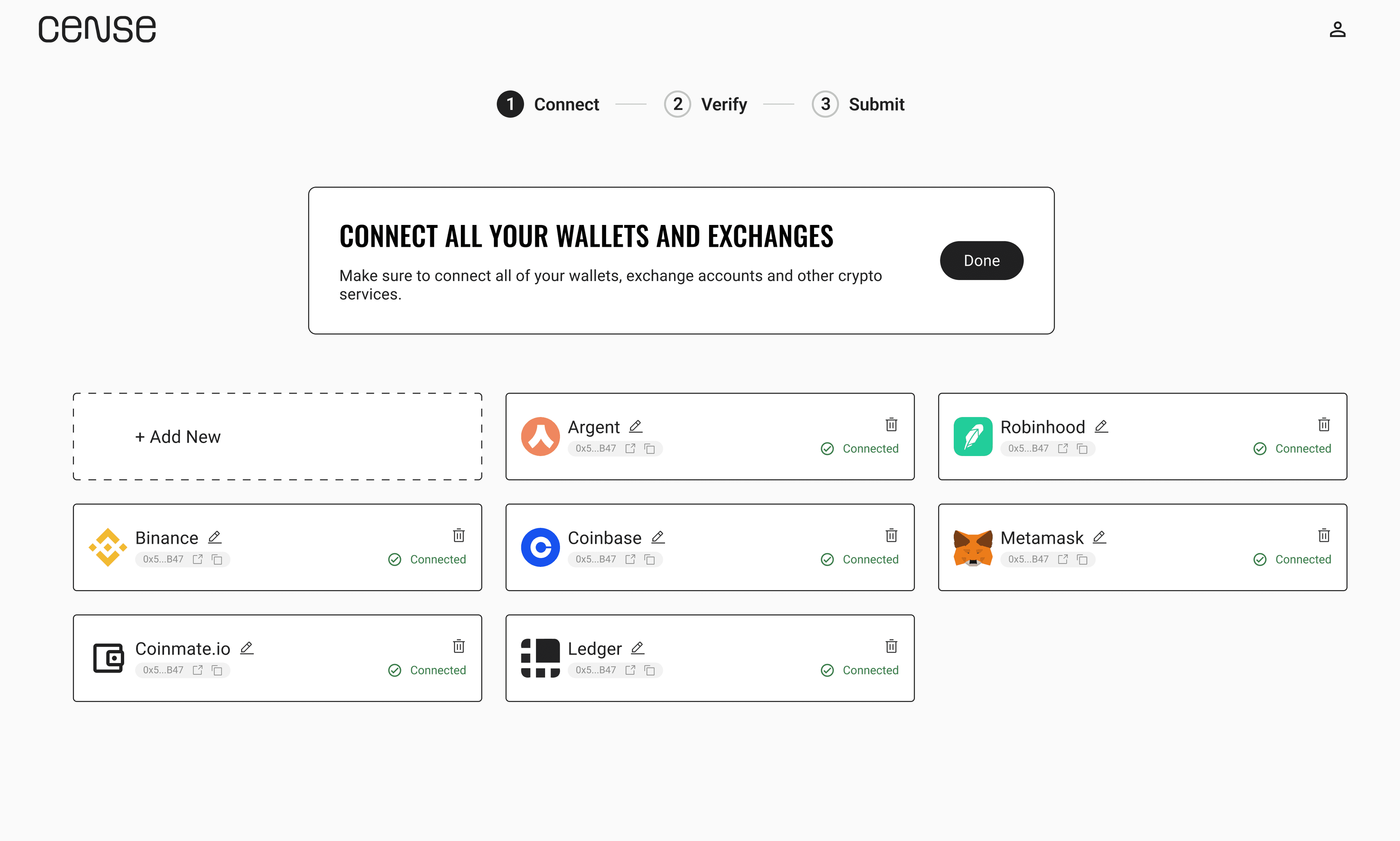
The client-facing entry point. A three step flow designed to feel fast for crypto holders and rigorous enough for banks to rely on for regulatory submission.

The crypto holder's first handshake with compliance.
The Connect Portal is the client-facing surface of Cense. It is where a crypto holder, someone who needs to prove to their bank that their assets are legitimate, connects every wallet and exchange they hold crypto on.
The stakes are high on both sides. For the crypto holder, this is sensitive financial data being handed to a third party. For the bank, the data collected here has to be complete, verified, and defensible enough to back a regulatory decision. The portal had to earn trust from someone handing over sensitive data, while producing output rigorous enough for a compliance officer to sign off on.
Three steps to a complete crypto picture.
Crypto data is sensitive. The longer the process, the higher the drop-off, and the lower the trust. We needed a flow that felt fast enough for a crypto holder to commit to, and rigorous enough for a bank to rely on.
Every step maps to a distinct moment of user commitment: Connect hands over the data, Verify proves ownership, Submit gives consent for analysis. Nothing is asked without a reason. Nothing is collected without the user understanding why.
The result is the shortest defensible path from wallet to report.
How we researched what users actually needed.
Before designing a single screen, we needed to understand what connecting crypto assets actually felt like from the user side. We ran three rounds of research: competitive analysis to map the landscape, a stakeholder workshop to align on assumptions, then interviews and usability tests to pressure-test everything against real behavior.


Since Cense lacks direct competitors, the research focused on crypto tax platforms with similar import interfaces, such as Cryptotaxcalculator, Koinly, and Accointing.
This session shaped and facilitated the development of initial assumptions, serving as a foundation for mockups, to be refined or validated through user research.
Two rounds were conducted with 24 testers of varying crypto expertise, using prototypes designed from theoretical assumptions.
of users hesitated when sharing wallet credentials. Trust came from bank association and transparent data handling, not from simplifying the technical steps.
of users completed the flow when guidance was provider-specific. Generic instructions caused drop-off at the exact moment users needed to act: API keys, hardware wallet pairing, exchange-specific settings.
When users could not find their provider, they entered it manually. When users could not find their provider, they entered it manually. We used those entries to prioritize which new provider flows to build next. Manual entry became our product roadmap.
One product. Five connection paths.
Each provider works differently. MetaMask connects automatically through the browser. Binance exposes a partial API key. Ledger requires on-device verification. Manual entry covers wallets with no direct integration. And some providers cannot be connected at all yet, so users still needed a path forward.
We mapped every case so users always knew exactly what to do next, regardless of where their assets lived.
 MetaMaskCCoinbase
 BinanceKKrakenBBitvavo
Advanced setups, custom API keys
Fallback to manual entry and logged for prioritization.
The strategy
Launch with the most used providers first, then expand. Each provider gets a dedicated screen with its own instructions, visuals, and error states so nothing feels like an afterthought.
The result
A growing library of provider flows the team can ship independently without redesigning the entire onboarding experience each time.


Admin Panel.
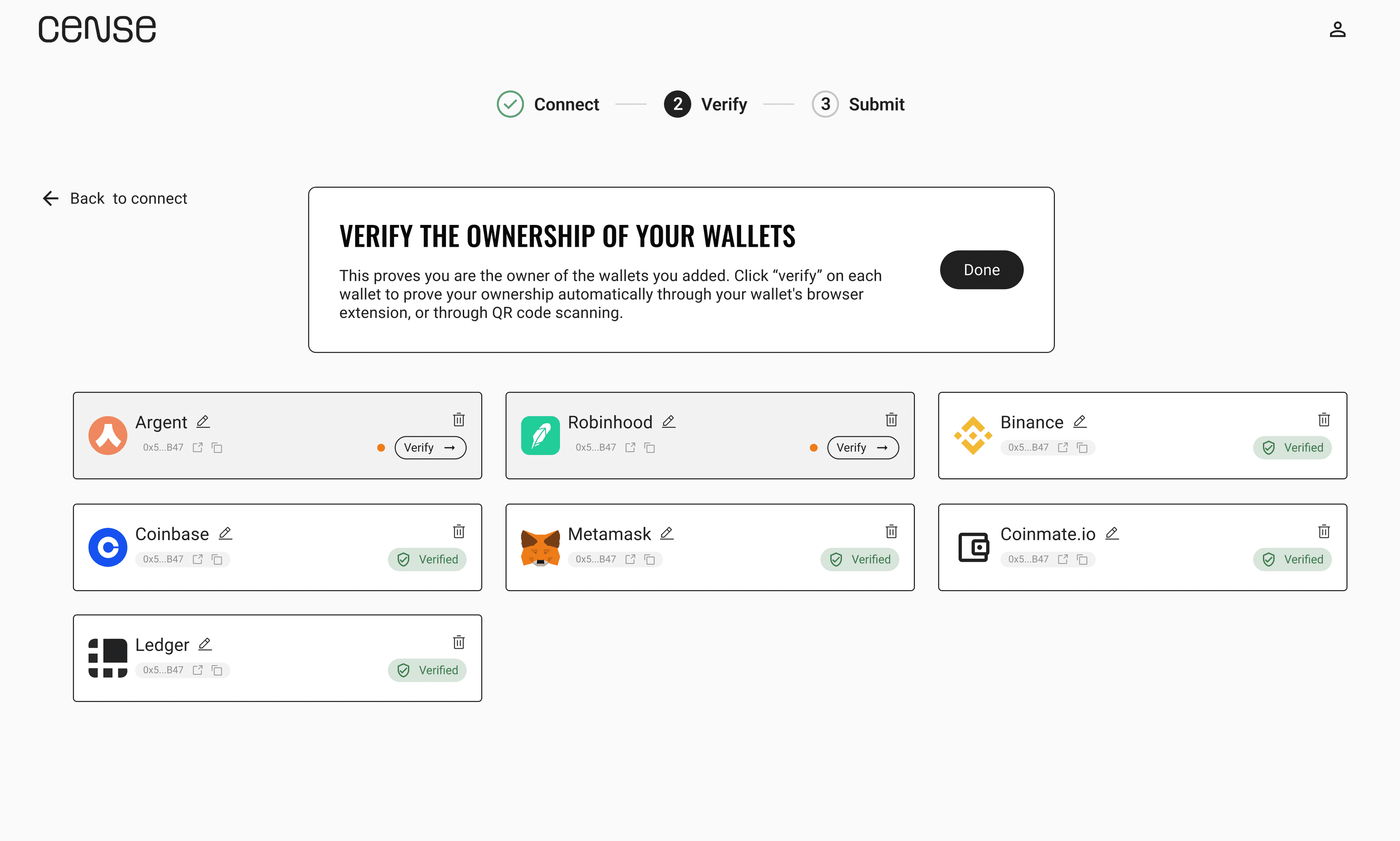
The compliance backbone. Where banks review submitted cases, track every client status in real time, and manage the full analysis pipeline from flag to resolution.
One surface. Zero spreadsheets.
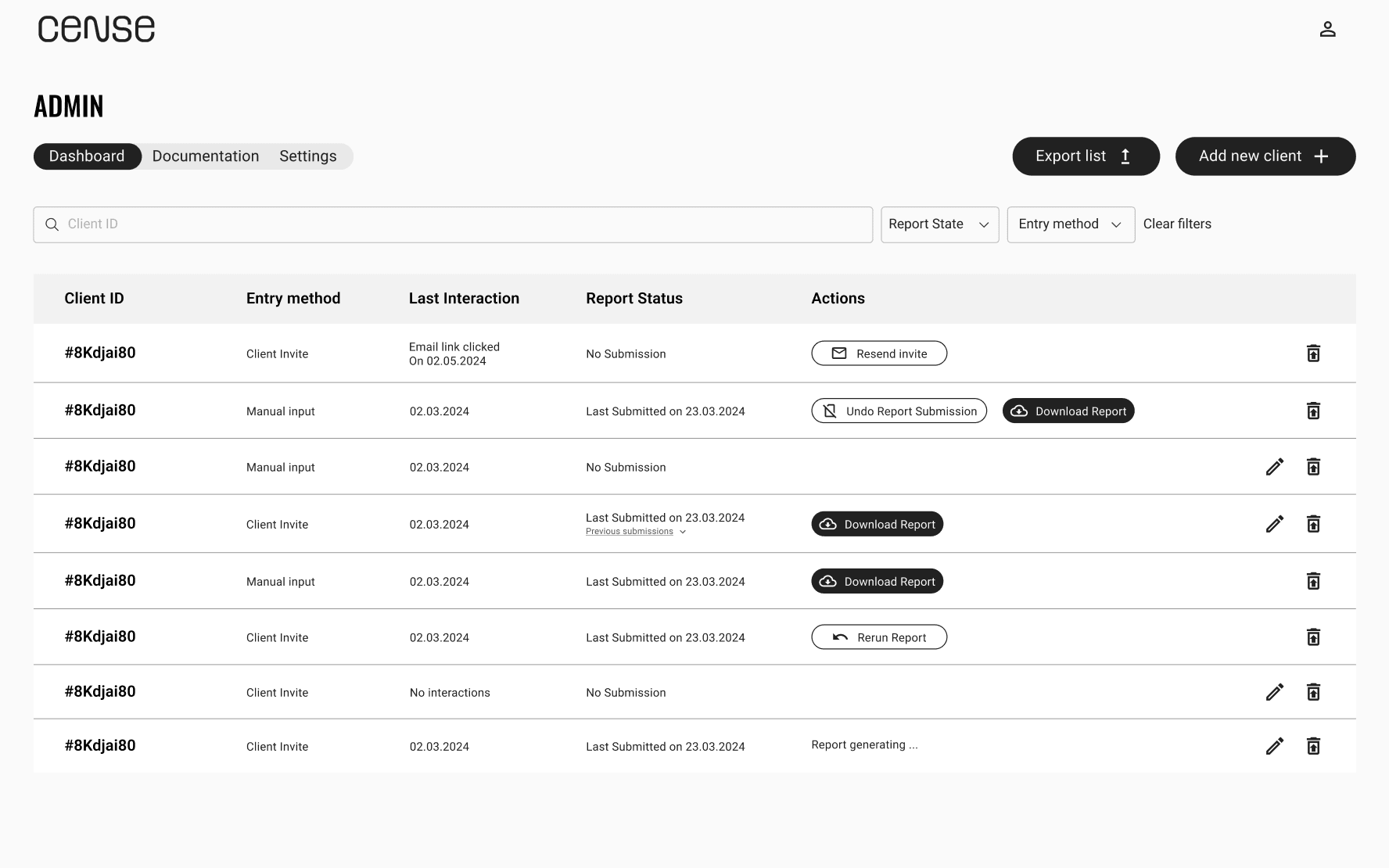
The compliance backbone. Where banks review submitted cases, track every client status in real time, and manage the full analysis pipeline from flag to resolution.
The Financial Economic Crime Specialist works inside a bank reviewing submitted crypto compliance cases. On any given day they are managing dozens of clients at different stages, waiting for submissions, chasing incomplete data, reviewing generated reports, flagging risk, and deciding who gets approved and who gets escalated.
Before Cense, this process lived in spreadsheets, email threads, and manual status checks. The Admin Panel needed to replace all of that with one surface where every case status was visible, every action was one click away, and nothing required a phone call to find out.
How we learned.
Together with compliance officers of varying crypto expertise, we shaped expectations to build the platform's iterations and assumptions.
Helped identify key touchpoints, pain points, and opportunities in their current workflow, focusing on how they manage multiple client assessments and reports.
Testing rounds were conducted with compliance officers from different financial institutions, using interactive prototypes to validate our assumptions and refine the interface.
Account lifecycle flow.
Task Analysis: Actions & Errors State Journey.
Problems solved. Features shipped.
Know at a glance which clients are stuck and why.
One-table dashboard, interaction history, status filters, clear action hierarchy.
Understand what went wrong without calling support.
Specified error types, clear descriptions, direct escalation path to Cense team.
Filter, re-run, export and redirect reports fast.
Advanced filtering and search, streamlined re-run logic, fewest clicks for repeated actions.


Risk Analysis Report.
The final deliverable. The document a compliance officer signs off on, attaches to a case file, or hands to a regulator. It has to read as authoritative and read fast.

The output compliance officers actually defend.
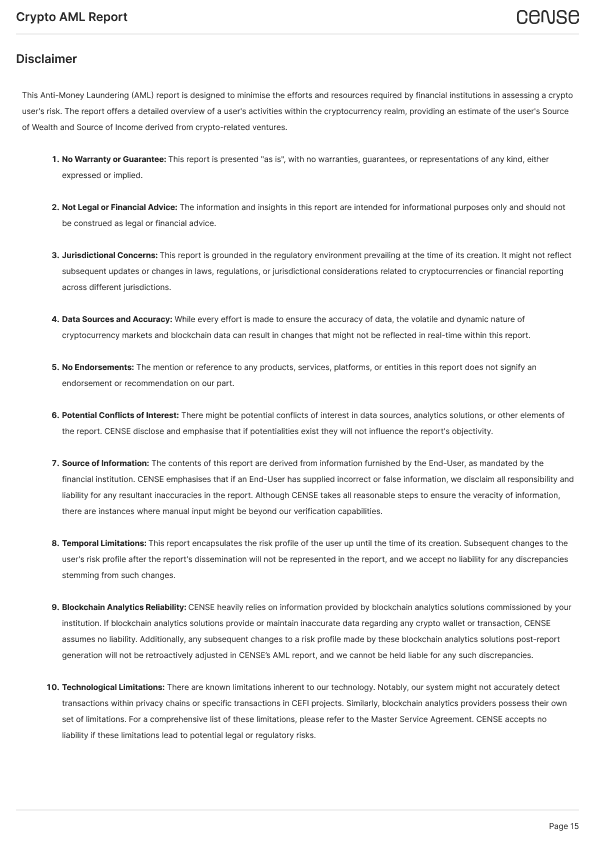
Once the data is in, Cense produces a Risk Analysis Report. The document a compliance officer signs off on, attaches to a case file, or hands to a regulator. It has to read as authoritative and fast.
But the most important design decision was not how it looked. It was what it refused to do. The report never tells a financial institution whether to accept or reject a client. It generates a risk score based on predefined rules and presents the evidence. Each institution applies its own compliance thresholds. The report informs. The institution decides.
This neutrality was non-negotiable. Different institutions prioritize different risk factors. Some only need EU-specific data. Others assess activity across multiple jurisdictions. The report had to support all of them without becoming a different document for each one.
How we learned what compliance officers actually need.
Conducted with compliance officers throughout the design process, not just at the start. Each new feature triggered a new round of interviews to validate interpretation of risk data.
We observed compliance officers reviewing reports in real time, tracking what they read first, what they ignored, where misunderstandings occurred, and how they expected information to be structured.
Two financial institutions validated the report during early development, confirming that the structure, hierarchy, and language matched real compliance workflows.
Systematically mapped the report review process to identify decision points, information hierarchy, and reporting requirements across different institution types.
Built for borders that crypto ignores.
Cryptocurrency is borderless. The report needed to account for regulations and risk across multiple jurisdictions, not just Switzerland or the DACH region. The team researched European and international AML and financial crime regulations to explain where risks originate and how they should be interpreted across countries.
Some institutions only require EU-specific information. Others assess activity outside Europe. The report accommodates both through dedicated regulatory sections that can be included or omitted based on each institution's internal compliance requirements.
Communicate complex risk data to both crypto specialists and non-crypto financial professionals.
Clear information hierarchy, plain language labels, risk score visualized as a spectrum not a number alone.
Inform without recommending. Each institution applies its own thresholds.
Risk score generated from predefined rules. No accept or reject verdict. Evidence presented, decision left to the institution.
Support different compliance policies across institutions and jurisdictions.
Report sections can be included or omitted per institution. EU-only and multi-jurisdiction use cases both supported.
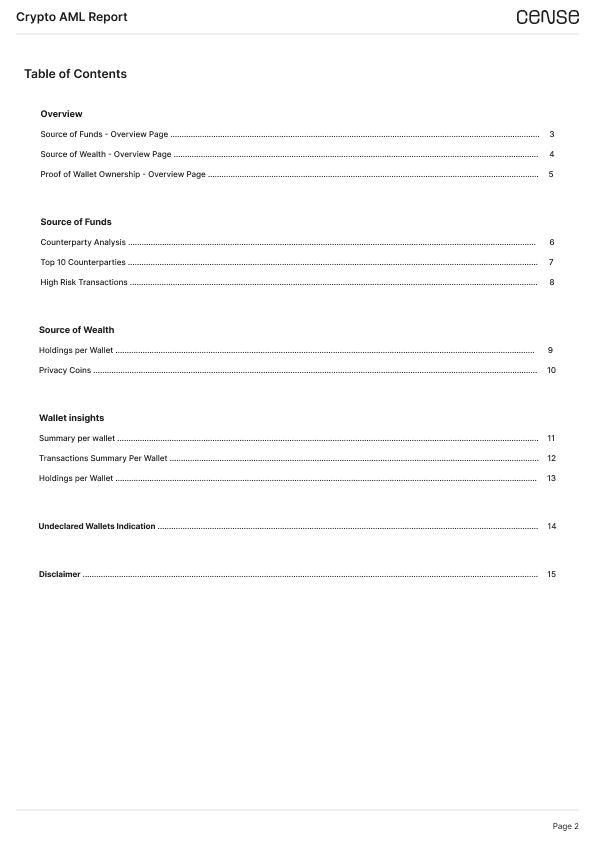
Five sections. One defensible picture.
- –Source of Funds
- –Source of Wealth
- –Proof of Wallet Ownership
- –Counterparty analysis
- –Top 20 counterparties
- –High risk transactions
- –Holdings per wallet
- –Privacy coins
- –Summary per wallet
- –Transaction summary
- –Holdings per wallet
- –Indication of wallets not declared during submission, flagged with certainty level
Each section can be included or omitted based on the institution's internal compliance requirements.

What I'd carry forward.
Compliance work has a reputation for being dry. The thing I learned designing Cense is that it's the opposite of dry, it's high-stakes. Every screen will be cited in a case file.
That sharpened the brief: design for trust, clarity and defensibility, not novelty. The visual quietness of the product is the point, the work is the work, the interface should get out of the way.
General Metrics & Outcomes
Exact numbers are subject to confidentiality agreements.